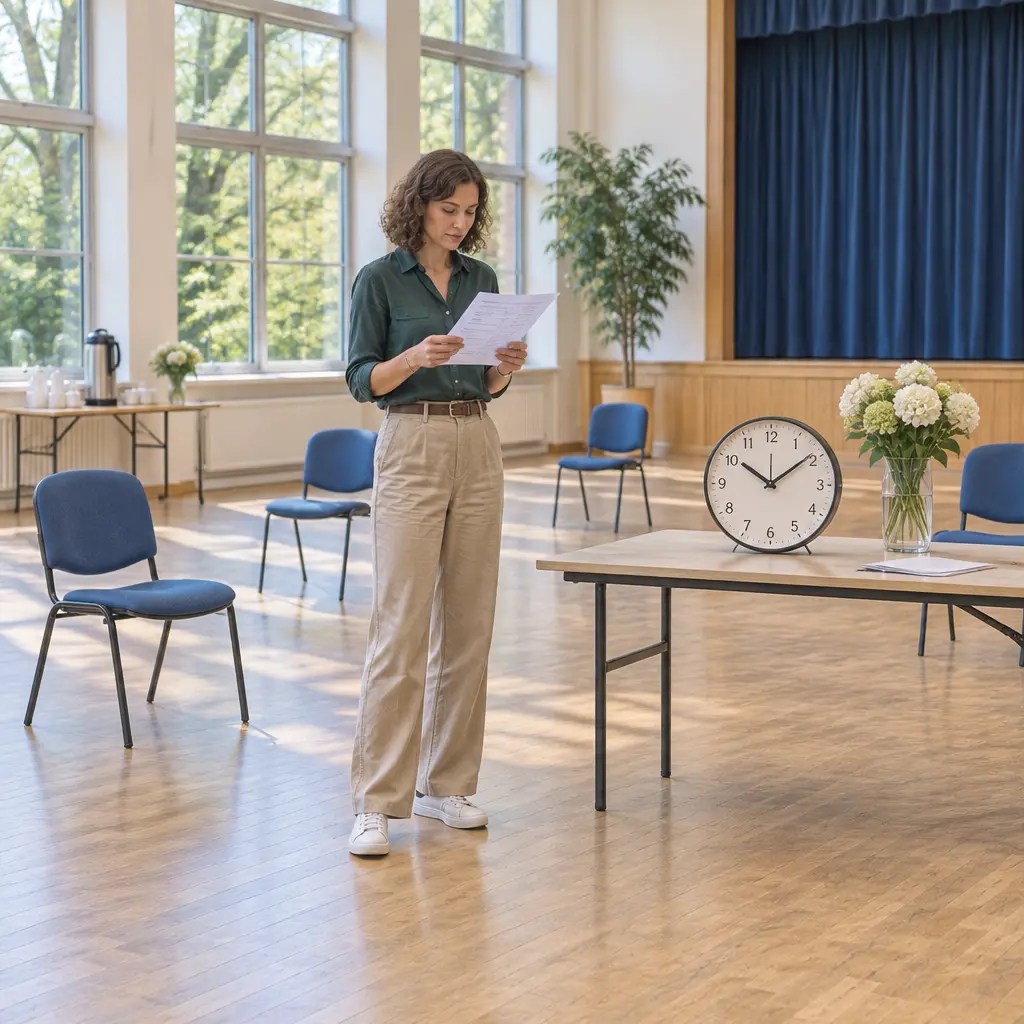
A realistic timeline is a plan that accounts not only for travel, setup, and task duration, but also for the human moments that make an event or day meaningful. Building buffer time for reflection, conversation, transitions, and unexpected emotion can improve participation and reduce pressure; it is not wasted time. This matters at a time when the American Psychological Association reports that stress is a common experience for U.S. adults, while event and project schedules often prioritize measurable logistics over people’s needs. The practical approach is to distinguish contingency padding from intentional emotional space, place both where they are needed, and review the schedule against real-world evidence rather than assuming every activity will run exactly on time.
Realistic Timeline Design and Emotional Buffer Time
Timeline realism is the degree to which a schedule reflects the time, dependencies, uncertainty, and human attention required to complete its activities. Emotional buffer time is a deliberately protected interval that gives people room to process, connect, recover, or respond without forcing the next activity to begin immediately. It differs from a generic contingency buffer: contingency time absorbs delays, while emotional time serves a human purpose even when everything runs on schedule.
This distinction applies to weddings and memorials, healthcare appointments, workshops, meetings, travel itineraries, and project plans. The U.S. Bureau of Labor Statistics’ American Time Use Survey tracks how people allocate time across daily activities, underscoring that a day is made up of competing demands rather than perfectly isolated tasks. Meanwhile, the American Psychological Association’s Stress in America research documents widespread stress among U.S. adults. Together, these realities make it prudent to plan transitions and emotional needs as part of the timeline—not as exceptions to it.
Timeline Realism Defines a People-Centered Schedule
There is no single universal industry definition of “timeline realism.” In project management, however, the Project Management Institute describes schedule management as planning and controlling the timing of project activities. Applied to human-centered scheduling, a realistic timeline is one whose durations, dependencies, and allowances reflect likely conditions, including the time people need to arrive, shift attention, make decisions, and respond emotionally.
Its key characteristics include credible activity durations, visible dependencies, transition time, a distinction between intentional pauses and delay reserves, and enough flexibility to adapt when reality diverges from the plan. Common forms include a logistics buffer, a transition buffer, an emotional buffer, and a recovery buffer. These categories can overlap, but identifying their purpose makes it less likely that a meaningful pause will be treated as expendable slack.
Contingency buffers absorb uncertainty
A contingency buffer is reserved time for foreseeable uncertainty, such as traffic, a late arrival, equipment setup, or a task taking longer than expected. Project Management Institute guidance on scheduling emphasizes estimating activity durations and managing schedule risk; in practice, teams can use past performance, expert estimates, or scenario planning to size reserves. A buffer should be based on the risks involved, not added as an arbitrary percentage that conceals an unrealistic plan.
For example, a facilitator might reserve ten minutes after a complex group exercise because earlier sessions show that participants need additional time to ask questions. If the group finishes on time, that interval can remain a useful transition rather than being filled automatically with another task.
Emotional buffers protect human transitions
An emotional buffer is protected time before or after an activity likely to prompt grief, vulnerability, celebration, conflict, or significant decisions. It allows people to compose themselves, speak privately, absorb information, or simply sit without being hurried into the next obligation. Unlike contingency time, it is valuable even if no delay occurs.
A healthcare appointment that includes difficult news, for instance, should not be designed as though the conversation ends precisely when the booked slot does. The National Institute of Mental Health describes stress as a response to challenging circumstances, while the National Cancer Institute’s communication resources emphasize responding to patients’ emotional concerns as part of care. These sources do not prescribe one standard buffer length; the appropriate amount depends on the activity, participants, and setting.
Transition and recovery buffers reduce schedule friction
A transition buffer is time for people to move between places, topics, or social roles. A recovery buffer is time to rest after sustained concentration, physical effort, or emotionally demanding interaction. Both are different from an empty gap: they have a clear function, such as travel, restroom access, quiet decompression, or changing equipment.
The Centers for Disease Control and Prevention’s guidance on workplace mental health recognizes the importance of supportive work environments and organizational practices. In a practical schedule, this can mean avoiding consecutive high-intensity meetings, allowing time to leave one room and enter another, and protecting breaks rather than treating them as optional catch-up periods.
Emotional Buffer Time Makes Schedules More Humane
Emotional buffer time makes a timeline more realistic because people do not switch instantly from one activity to another. The useful amount depends on the emotional intensity, whether participation is voluntary, the size and needs of the group, and what follows. A short pause may be enough after a routine discussion; a memorial, disclosure, or difficult clinical conversation may require a longer interval and an option to step away.
Sensitive conversations need room for response
Sensitive conversations include discussions of health, loss, performance, family conflict, or major change. A schedule that allows only time for the speaker’s prepared remarks can leave no space for questions, emotion, or clarification. Build in a pause after the central conversation, identify a private place where appropriate, and avoid placing a demanding activity immediately afterward.
For example, a manager delivering difficult feedback can reserve time for the employee’s response and agree on a follow-up rather than ending the meeting at the first sign of emotion. The buffer does not guarantee a particular reaction; it signals that listening and understanding are part of the work.
Ceremonies and gatherings benefit from intentional pauses
Ceremonies and gatherings often contain moments that cannot be reduced to a checklist: greetings, photographs, tributes, reunions, or spontaneous conversation. A wedding schedule, for example, can protect time after a ceremony for congratulations and family photographs instead of expecting guests to move instantly to the next location. A memorial can include quiet time after a tribute before the gathering shifts to refreshments or practical announcements.
These are practical examples rather than standardized timing rules. The schedule should reflect the participants, cultural practices, venue constraints, and accessibility needs. A visible pause also helps hosts and staff understand that the moment is intentional, not a mistake to be corrected by rushing everyone forward.
Meetings and workshops need cognitive breathing room
Cognitive breathing room is time to think, write, ask questions, or shift attention between topics. In a workshop, placing a reflective prompt immediately before a break can give participants time to process without requiring them to share publicly. In meetings, a short interval after a decision can allow people to clarify responsibilities before moving to a new subject.
The American Time Use Survey provides a useful reminder that work competes with care, household responsibilities, and other demands. Meeting organizers can respond by publishing realistic start and end times, avoiding back-to-back sessions where possible, and offering asynchronous ways to contribute for people who need more time to reflect.
Build Buffers Into the Timeline Without Losing Clarity
A practical timeline makes buffer purpose explicit. Labeling a block “travel and transition,” “quiet reflection,” or “contingency” helps participants and organizers protect it. This is more effective than hiding every reserve inside activity estimates, because visible time can be managed deliberately and reviewed after the event.
Map intensity, dependencies, and likely friction points
Begin by listing activities, locations, responsible people, dependencies, and the emotional or cognitive intensity of each item. Mark likely friction points, such as a room change, an unfamiliar process, a difficult announcement, or a decision that requires discussion. Estimate task durations using prior experience where available, then add the buffer that addresses the specific risk or human need.
- Separate setup, activity, travel, and reset time instead of combining them into one optimistic estimate.
- Place emotional buffers after—not merely before—activities that may prompt a strong response.
- Keep high-stakes conversations away from hard stop times when possible.
- Provide a clear option to pause, leave, or rejoin without explanation where appropriate.
Use evidence and scenarios to size the buffer
Use historical durations, attendee needs, travel estimates, and known constraints to set reasonable allowances. If no prior data exist, create best-case, typical, and difficult-case scenarios rather than pretending uncertainty does not exist. Afterward, compare planned and actual timing: repeated overruns may show that task estimates are too short, while unused time may indicate that a buffer can be adjusted or repurposed.
The Bureau of Labor Statistics’ time-use data are useful for understanding broad patterns in how people spend their days, but they do not determine how long a particular emotional pause should be. That decision requires context and feedback from the people affected. Treat numerical estimates as planning aids, not as a substitute for consent, accessibility, or judgment.
Communicate flexibility and preserve participant choice
A realistic schedule tells people what is fixed and what can shift. Hosts can explain that a pause is intentional, name the next expected start time, and identify available support or quiet space. For workplace or care settings, participants should not be pressured to disclose private feelings in order to justify taking a break.
This approach balances structure with dignity: a schedule remains understandable while allowing people to respond to what is happening. Where timing is regulated or operationally critical, organizers should preserve required milestones and place flexibility around them rather than promising that every element can move.
Real-World Applications Show Why Logistics Are Not Enough
The same planning principle applies across very different settings: a schedule should account for both the activity and its human consequences. A hospital clinic, a community ceremony, and a project workshop have distinct constraints, but each can use visible transitions, realistic estimates, and purposeful pauses.
Healthcare appointments
A clinician may schedule extra time for a consultation involving complex choices, ensure that patients know how to ask follow-up questions, and avoid assuming that emotional discussion ends when the formal appointment does. The National Cancer Institute’s communication guidance supports attention to patients’ concerns and clear information exchange. Operational limits still matter, so a clinic can combine an appropriate appointment length with a follow-up channel for questions that emerge later.
Memorials and family gatherings
A memorial organizer can reserve time after readings or tributes for quiet, informal conversation, and practical support. That time may reduce pressure on attendees to move immediately from grief into a reception or travel. The appropriate format should be shaped with the family and community, since cultural and personal expectations differ.
Project planning and team workshops
A project lead can include time for handoffs, review, and decisions rather than estimating only the production work. After a demanding planning session, a short break or written reflection can help participants capture unresolved questions. The Project Management Institute’s scheduling principles are useful here: dependencies and risk should be managed openly, while human-centered buffers make the schedule more workable for the people doing the work.
Conclusion: Treat Buffer Time as Part of the Plan
Timeline realism means planning for actual durations, dependencies, uncertainty, and human needs. Contingency buffers absorb delays; emotional buffers allow people to process; transition and recovery buffers make changes of place, focus, or intensity more manageable. These categories turn the schedule from a sequence of logistical demands into a plan that can function in real conditions.
The broader implication is simple: efficiency is not the same as eliminating every pause. A schedule that leaves room for meaningful moments can support clearer communication, better participation, and more humane experiences. For your next event, meeting, or project, identify the most emotionally demanding transitions, protect time around them, and review the plan with the people who will live by it.
Sources: Project Management Institute, Practice Standard for Scheduling, https://www.pmi.org/standards/scheduling; U.S. Bureau of Labor Statistics, American Time Use Survey, https://www.bls.gov/tus/; American Psychological Association, Stress in America, https://www.apa.org/news/press/releases/stress; National Institute of Mental Health, “I’m So Stressed Out! Fact Sheet,” https://www.nimh.nih.gov/health/publications/so-stressed-out-fact-sheet; National Cancer Institute, Communication in Cancer Care (PDQ®)–Health Professional Version, https://www.cancer.gov/about-cancer/coping/adjusting-to-cancer/communication-hp-pdq; Centers for Disease Control and Prevention, Workplace Health Model, https://www.cdc.gov/workplace-health-promotion/php/about/index.html