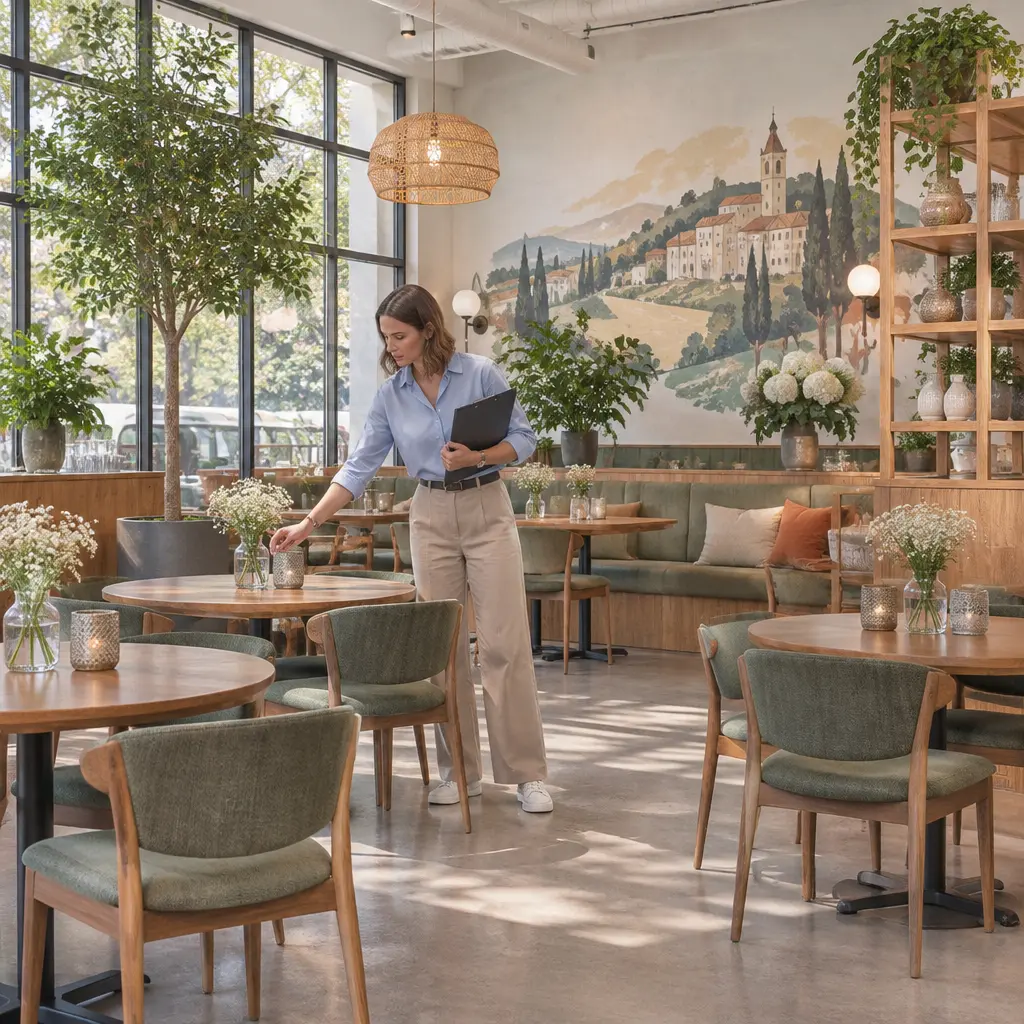
Décor budget allocation is the process of deciding how limited design funds should be spent across a venue’s physical environment. For hotels, restaurants, event spaces, and other hospitality businesses, a practical priority is to invest first in guest touchpoints—the places and objects people see, use, or rely on during their visit—rather than concentrating the budget on Instagram backdrops alone. This approach connects décor choices to comfort, usability, brand consistency, and perceived value. It also recognizes that visual appeal matters: research from the American Express 2023 Global Travel Trends Report found that 70% of respondents said they seek out travel experiences they can share on social media. The goal is not to reject photogenic design, but to make it serve a satisfying guest experience.
Hospitality Décor Budget Allocation Prioritizes Guest Touchpoints
There is no universal, research-established percentage for allocating décor funds between touchpoints and photo backdrops. The right split depends on the venue, its condition, guest feedback, operational needs, and project scope. A sound allocation begins by identifying high-frequency interactions and visible service failures, then reserving a deliberate portion of the budget for distinctive visual moments. This is more defensible than treating social-media appeal as a substitute for comfort, accessibility, maintenance, or coherent design.
The distinction matters because guests experience a venue as a sequence, not a single image. A welcoming entrance, easy-to-read wayfinding, comfortable seating, clean washrooms, and well-lit tables can shape the visit repeatedly. A backdrop may create a memorable photograph, but it usually serves a narrower purpose. The American Express survey demonstrates social sharing’s relevance; it does not show that backdrops alone produce satisfaction or repeat visits. Operators should therefore weigh both experience quality and shareability rather than relying on one metric.
Guest Touchpoint Décor Defines Practical Investment Priorities
A guest touchpoint is an interaction point where a guest encounters the venue’s space, service, information, or amenities. In services research, the broader “servicescape” describes the physical environment in which service is delivered and experienced. In their foundational 1992 article, “Servicescapes: The Impact of Physical Surroundings on Customers and Employees,” Mary Jo Bitner explains how physical surroundings can affect customers’ and employees’ responses and behavior. Applied to décor budgeting, this means assessing not just whether an object looks attractive, but how it affects comfort, navigation, perception, and work.
Touchpoints can be grouped by the guest journey: arrival and orientation; waiting and seating; ordering or service; dining, working, or attending an event; and washroom use or departure. Their importance varies by business. A hotel may prioritize the lobby, reception, guest-room lighting, and corridor wayfinding; a café may focus on the queue, counter, seating, and pickup area. The practical connection is frequency and consequence: the more often guests encounter a feature—or the more disruptive its failure—the stronger its claim on the budget.
Arrival and Wayfinding Touchpoints
Arrival touchpoints include the entrance, reception or host station, queue, signage, and the route to the main service area. Their décor should make the venue legible and welcoming: clear sightlines, visible signs, appropriately placed lighting, and a reception point that is easy to identify. A beautiful entrance that obscures the host stand or creates a confusing route is an expensive visual gesture with a functional drawback.
Accessibility should be treated as part of the design brief, not as an optional finishing touch. The U.S. Department of Justice’s 2010 ADA Standards for Accessible Design establish requirements for accessible routes and other elements in covered facilities. Before choosing decorative features, operators should confirm that layouts, circulation paths, and signage remain compliant. A modest investment in legibility and unobstructed movement can benefit guests with disabilities, older visitors, families, and anyone arriving in an unfamiliar space.
Seating, Lighting, and Comfort Touchpoints
Seating and lighting directly affect how guests use a venue. Chairs, tables, upholstery, acoustic treatments, and task or ambient lighting should be selected around the activity: dining, waiting, working, or attending a performance. A visually striking chair that is uncomfortable, unstable, or difficult to clean can undermine the overall impression. Likewise, lighting that photographs well but makes menus hard to read may privilege the image over the visit.
Comfort decisions should be validated in the actual space. Test sample furniture at realistic table heights, check glare at different times of day, and consider how sound and crowding affect conversation. The Centers for Disease Control and Prevention’s built-environment guidance emphasizes that design features such as access and walkability can influence how people use places; for hospitality interiors, the analogous lesson is to evaluate the environment through real movement and behavior rather than renderings alone.
Service, Washroom, and Departure Touchpoints
Service touchpoints include ordering counters, menu displays, table settings, payment areas, and pickup shelves. Washrooms and exits also leave strong practical impressions because cleanliness, maintenance, and clear instructions are easy for guests to notice. Décor budgets should account for durable finishes, replaceable components, adequate lighting, and surfaces that staff can maintain efficiently. An attractive but delicate feature can generate recurring repair costs that diminish its initial value.
These areas connect décor quality to operations. Before approval, managers can ask staff which fixtures are frequently damaged, which signs guests overlook, and where queues or service delays occur. This creates a bridge from guest-facing design to employee workflow: a better-arranged counter or clearer pickup point can improve both the guest’s understanding and staff efficiency.
Instagram Backdrop Décor Serves a Distinct but Limited Role
An Instagram backdrop is a deliberately photogenic feature intended to encourage guest photography and social sharing. Examples include a branded mural, floral installation, neon phrase, distinctive mirror, or sculptural feature wall. These elements can help communicate a venue’s identity and create a recognizable image, but they should be considered one category of décor—not the whole design strategy.
The American Express 2023 Global Travel Trends Report reported that 70% of surveyed respondents seek travel experiences they can share on social media. This finding supports the relevance of shareable moments, particularly for travel and hospitality marketing. It does not establish that a specific backdrop will increase revenue, nor that social posting should outrank basic guest needs. Operators should treat the statistic as evidence of audience interest, then test whether a proposed installation fits their own customer base and brand.
Branded Photo Moments
A branded photo moment is a designed setting that makes a venue identifiable in guest-created images. It works best when the brand is expressed through materials, color, lighting, and a distinctive point of view rather than a forced logo placement. Its value depends on visibility, usability, and the likelihood that guests will encounter it naturally. A backdrop tucked behind a service bottleneck may create congestion; one integrated into a lounge or arrival area can add character without interrupting circulation.
Before funding one, estimate its full lifecycle cost: fabrication, installation, lighting, cleaning, repairs, seasonal updates, and eventual removal. Compare that total with the expected useful life and with other projects, such as replacing worn seating or improving wayfinding. The relevant measure is not simply whether guests take photographs, but whether the feature contributes to the intended brand experience at an acceptable cost.
Shareability Without Sacrificing Function
Shareable décor can be integrated into functional touchpoints. A well-designed host wall can provide clear arrival information and a compelling visual identity; an attractive menu board can improve legibility while reinforcing the brand; and comfortable seating can be arranged around a distinctive material or color palette. This hybrid approach lets one investment solve a practical problem and support memorable imagery.
The test is whether the feature remains useful when no one is taking a photograph. If the answer is yes—because it improves comfort, orientation, lighting, or atmosphere—it is more resilient than a purely decorative installation. If the feature is primarily a marketing asset, its cost should be assessed against other marketing channels and evaluated with campaign-specific measures.
Budget Allocation Connects Guest Value, Risk, and Return
A practical allocation method scores proposed projects against guest impact, frequency of use, operational benefit, brand value, cost, durability, and risk. This avoids unsupported rules such as assigning a fixed percentage to backdrops. Managers can rank projects by urgency and evidence, then reserve funds for both essential improvements and selected brand expressions.
Use a Weighted Prioritization Score
A weighted score turns subjective proposals into comparable choices. Rate each project, for example, from 1 to 5 on guest comfort, frequency of exposure, accessibility or safety relevance, operational benefit, brand distinctiveness, durability, and cost. Give higher weights to essential guest outcomes and lower weights to optional visual novelty. The exact weights should reflect the venue’s strategy; they are a management tool, not an industry benchmark.
- Fund first: safety, accessibility, maintenance failures, confusing circulation, and visibly worn high-use items.
- Fund next: improvements that combine guest comfort with staff efficiency, such as better queue organization or clearer service points.
- Fund selectively: distinctive photo moments that support the brand and do not compromise function.
- Defer or redesign: features with high upkeep, low exposure, weak brand relevance, or avoidable circulation problems.
Measure Outcomes Before and After Installation
Measurement helps distinguish a successful investment from an attractive assumption. Establish a baseline before work begins and compare results afterward, allowing for seasonality and other changes. Useful indicators include guest comments about comfort or navigation, complaint frequency, maintenance calls, seat or area utilization, queue time, repeat visits where available, and the number or reach of tagged social posts. No single metric proves causation; a backdrop may coincide with increased posts without being the reason for higher sales.
For a small venue, a simple observation log and short guest survey may be sufficient. Larger operators can compare similar locations or run a limited pilot before a full rollout. Social metrics should be interpreted alongside service and satisfaction indicators: a feature that earns attention but creates congestion or increases cleaning demands may not be a net improvement.
Real-World Application: A Café Renovation Decision
Consider a café deciding between a decorative mural and improvements to its entrance, queue, and seating. The operator first records recurring guest questions, peak-hour queue patterns, furniture condition, and staff feedback. If guests regularly miss the ordering point and existing chairs are worn, the evidence supports prioritizing clear signage, a more legible counter, and durable seating. A smaller mural can then be incorporated where it does not obstruct movement and can be photographed naturally.
After the renovation, the café can compare queue observations, guest comments, repair frequency, and social mentions with its baseline. The example illustrates a decision process rather than a guaranteed result: diagnose the experience, prioritize high-impact touchpoints, integrate shareability where it fits, and evaluate actual outcomes. For a hotel or event venue, the same method applies, but the relevant touchpoints and measures will differ.
Conclusion: Put Guest Touchpoints Before Standalone Backdrops
Décor budget allocation is strongest when it begins with the servicescape and the guest journey. Arrival, wayfinding, seating, lighting, service areas, washrooms, and departure points affect how people use and judge a venue. Instagram backdrops can support identity and social sharing, and the American Express survey indicates that shareable experiences matter to many travelers, but that evidence is not a reason to neglect function.
For the next décor project, document guest and staff pain points, check accessibility and maintenance needs, score options against clear criteria, and track outcomes after installation. Make photogenic features earn their place by complementing a useful, comfortable experience. Further reading on servicescapes, accessible design, and customer research can help teams turn aesthetic ideas into evidence-informed investments.
Sources: American Express, 2023 Global Travel Trends Report, https://www.americanexpress.com/en-us/travel/discover/get-inspired/Global-Travel-Trends; Bitner, Mary Jo, “Servicescapes: The Impact of Physical Surroundings on Customers and Employees,” Journal of Marketing, 1992, https://doi.org/10.1177/002224299205600205; U.S. Department of Justice, 2010 ADA Standards for Accessible Design, https://www.ada.gov/law-and-regs/design-standards/2010-stds/; Centers for Disease Control and Prevention, Healthy Community Design, https://www.cdc.gov/healthy-places/